- This event has passed.
Digital Exhibit – Maxville: Multicultural Timber History Through an Archaeological Lens

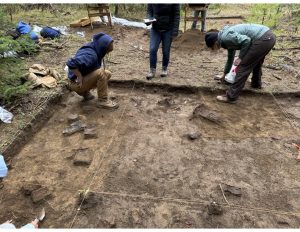 Maxville was a company logging town in Wallowa County, Oregon established by the Bowman-Hicks Lumber Company of St. Louis, Missouri. It was a component of the rapidly expanding industrial logging industry in the early 20th century, and despite exclusion laws that made it illegal to be Black in Oregon, Bowman Hicks moved dozens of African American families to northeast Oregon, families whose members were skilled lumbermen in the American South. Until disbanded by the company in 1933, some 400 residents of Maxville harvested trees and lived their daily lives in a community that included white and black neighborhoods and schools, an integrated baseball team, a hotel, a post office, a jail, an administrative center, and a narrow-gauge railway.
Many residents, including African Americans, remained living at Maxville through the 1940s, and their descendants still live in Wallowa County today. This archaeology exhibit explores the PNW timber industry, diaspora and dislocation using geolocation methodologies and archaeological protocols to uncover two dwellings that reveal insights over 100 years later of family, daily life, work, and recreation activities of Maxville residents.
This online exhibit runs August 12 through September 18, and is brought to us by Maxville Heritage Interpretive Center. The exhibit is sponsored, in part, by the Oregon State Capitol Foundation.
 CHG events sponsored by the Oregon State Capitol Foundation, a non-profit 501c3 organization.